Six Tips for Preventive Building Maintenance
Preventive maintenance is an essential part of property management, ensuring buildings last longer and work better, whether they are multifamily complexes or condominiums. Taking care of both the building envelope – roofs, walls, and exterior components – and proactively monitoring central systems can help extend the life of a property and avoid unexpected problems. Here are a few fundamental tips that should be part of every community’s preventive maintenance practices:
Observe Changes. Start with simple yet effective steps of paying close attention to the roofline, gutters, downspouts, and shingles. Addressing clogged gutters or misdirected downspouts can prevent water damage and ensure proper drainage away from the building.
Protect Pipes . Combat freezing temperatures by maintaining pipes and ensuring adequate heating throughout the property. Address leaks promptly to prevent water intrusion, which can lead to significant structural issues over time.
Maintain HVAC Systems. Regularly changing HVAC filters is a simple yet impactful measure to extend the system's lifespan. What’s more, it can improve energy efficiency and enhance indoor air quality.
Monitor Safety Systems. Monitor safety systems such as smoke detectors, fire pump systems, sprinklers, and door security. Proactive examination of these systems ensures that they function optimally, enhancing overall building operation and safety.
Be Proactive. Adopt a proactive rather than reactive approach to maintenance. Pay attention to minor issues and signs that may indicate potential problems. Addressing these early can prevent larger issues and costly repairs down the line.
Schedule Inspections. Implement quarterly walks coupled with safety inspections. These inspections should include filter changes, smoke alarm checks, leak assessments, and overall system evaluations. Catching issues early can prevent escalation and minimize disruptions to residents.
While it may sound simple, taking these few key steps can help identify potential problems early and limit exposure to bigger maintenance problems. Managers who proactively prioritize preventive maintenance not only help protect property values, they also create a reliable and comfortable environment for residents.
Why a Property Management Firm Is Essential to Multifamily Property Development
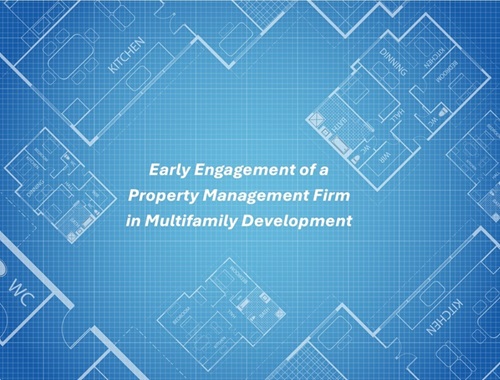
When it comes to developing multifamily properties, the importance of early engagement with a property management firm cannot be overstated. This strategic partnership ensures that the end result is both attractive and functional for residents. Let’s explore how involving property management from the outset can be a game-changer for multifamily developers.
Resident-Centric Design
Property managers bring a unique perspective to the table by evaluating designs from the lens of a resident. They focus on how residents will perceive and interact with the space on a daily basis. Property managers also bring focus to how a resident accesses the building and, equally important, how to prevent access to non-residents. From virtual walkthroughs to analyzing floor plans, property managers assess critical aspects such as accessibility to amenities, placement of utilities like trash cans and recycling bins, and the overall flow of the living space.
Consider a scenario where the architect planned closet doors to swing out in smaller units. A property manager's insight might highlight the need for sliding closet doors to accommodate essential furniture like nightstands, enhancing the livability of the space. These nuanced adjustments can significantly impact resident satisfaction and comfort.
Marketability and Flexibility
Engaging property management early also ensures a more marketable product. By understanding diverse resident preferences, management firms can advise on design elements and issues that appeal to a broader audience. For instance, in a community with varying needs, suggesting a mix of townhomes with and without garages can enhance market penetration and cater to different lifestyle preferences. Some prospective residents may prefer the garage for additional storage while others may prefer additional conditioned space, in lieu of the garage, for a den or home office.
Early collaboration also fosters flexibility in design choices. Management firms can anticipate operational challenges and suggest solutions during development. These can include optimizing systems for trash disposal and considering maintenance access points, as well as placement of mailboxes to ensure USPS requirements for access and design are met. Addressing these issues early mitigates future operational hurdles over the lifetime of the property.
Cost-Efficiency and Risk Mitigation
One benefit of engaging early with property managers is more cost-efficient design decisions. Identifying potential maintenance issues upfront, such as inaccessible water supply lines or impractical appliance placements, prevents costly change orders down the line. Understanding and anticipating resident needs can help developers ensure that the property is not just aesthetically pleasing but also functional, reducing the likelihood of resident complaints and turnover.
Holistic Approach to Project Management
Beyond design input, property managers contribute to a holistic approach to project management. They help ensure small details that can have a big impact on residents aren’t overlooked. For instance, developments that include the creation of new roads not only require registration of road names with the municipality, but also with online resources such as Google maps. Miss this step and new residents may become frustrated when delivery and transportation services cannot find their location.
Property management firms help integrate marketability, branding, and operational strategies into the development process, aligning the project's goals with resident expectations and industry standards. This comprehensive approach ensures a smooth transition from concept to delivery and seamless ongoing management post-construction.
Ensuring Long-Term Sustainability
By challenging architects and design teams, property management firms advocate for long-term sustainability. They prioritize not just visual appeal but also durability and functionality, ensuring that the property remains attractive and operational for years to come. This proactive approach minimizes future maintenance issues and reinforces the property's value proposition.
In the end, making a strategic investment upfront to engage property managers early in the development process can yield multiple, long-term benefits. From enhancing resident satisfaction and marketability to reducing costs and ensuring long-term operability, this collaborative approach sets the stage for successful property development, efficient ongoing management, and resident appeal and satisfaction. By bridging the gap between design vision and resident experience, management firms can play a pivotal role in shaping thriving communities.
For more information about WPM’s pre-development consulting services, email us at [email protected] .
Managing the financial health of an association requires diligence, foresight, and a commitment to best practices. Whether you're a seasoned board member or newly appointed, ensuring your association's financial stability is paramount to its long-term success. Here are ten tips to guide associations in navigating their financial landscape:
Evaluate Yearly Performance. Take stock of your association's financial performance on a year-to-year basis. Are you consistently ending the fiscal year with a budget surplus or facing losses? Identifying trends can help pinpoint areas for improvement and form future budgetary decisions.
Prioritize Expense Management . Community association budgets are primarily expense-driven. When crafting budgets, focus on scrutinizing expenses first. While it may be tempting to avoid increasing assessments, neglecting to adjust for inflation or rising costs can lead to financial strain in the long run.
Avoid Unrealistic Budgeting . Beware of passing unrealistic budgets that fail to accurately reflect the association's actual expenditures. Cutting essential services or amenities to artificially lower assessments can compromise the community's well-being and lead to dissatisfaction among residents.
Implement Incremental Assessment Increases. Embrace best practices by incrementally increasing assessments by 2-3% annually. This proactive approach ensures that your association stays ahead of inflation and maintains sufficient revenue to meet its financial obligations.
Fund Reserves Adequately. Prioritize funding reserves in accordance with state laws and reserve study recommendations. Adequate reserves are essential for addressing deferred maintenance, unforeseen repairs, and capital improvements without resorting to special assessments or loans.
Be Cautious About Deferring Maintenance . Budgets and reserves should be structured to cover routine upkeep as well as long-term capital projects. Are you deferring regular maintenance due to lack of funds? This not only may be a sign of poor financial health for an Association, it can also lead to more significant issues and increased costs down the line.
Review Monthly Financials . Actively engage with your association's financial statements on a monthly basis. Don't hesitate to ask questions and seek clarification from your management company or financial professionals. Regular monitoring can help identify potential issues early on and allow for timely adjustments.
Maintain Adequate Cash Reserves . Aim to maintain a minimum of two months' worth of assessments in your association's bank account at the end of each month ( after paying that month’s expenses). Building up cash reserves provides a financial buffer against unexpected expenses, delinquencies, or revenue shortfalls.
Monitor Equity and Retained Earnings. Keep a close eye on your association's equity, or retained earnings, and aim for a balance equivalent to 10-20% of your annual assessments. Healthy equity levels indicate financial stability and provide reassurance to stakeholders.
Seek Professional Guidance When Needed. When in doubt, seek out assistance from your community manager or other financial experts specializing in community associations. Their insights and guidance can be valuable in understanding your association’s financial position and helping navigate complex financial matters.
Ultimately, prioritizing the financial health of your association is crucial for its sustainability and long-term viability. By following these tips and maintaining focus on financial management, associations can thrive and fulfill their mission of serving their communities effectively.
The Power of Community Partnerships: A Q&A with Franklyn Baker, President & CEO of United Way of Central Maryland
Community partnerships have been a longstanding part of WPM’s commitment to giving back. The upending nature of the pandemic is creating greater need for many families and communities. We recently spoke with Franklyn Baker, President & CEO of United Way of Central Maryland (UWCM), about how organizations are responding and his perspective on the future.
WPM : How would you describe the mission of United Way of Central Maryland and the organization’s focus before COVID-19?
Baker : The mission of United Way is to improve lives. We do that in two ways – by empowering leaders and by mobilizing individuals to have a powerful impact in our communities. When I say “leaders,” I’m not simply talking about those in government or in the board room; I’m talking about individuals at any level who are stepping up as advocates, whether in an organization or as a community member. UWCM has always been about providing help whenever and wherever it is needed. Our vision is happy, thriving communities where all people live their best lives – on their own terms.
WPM: How has COVID-19 changed things for UWCM and your work with families and communities?
Baker: Like many other organizations, we have really been forced to reimagine how we work, from service delivery, to grantmaking with nonprofits, to how we collaborate and partner with donors, to how we engage and connect with our affinity groups such as Leaders United, Women United, Tocqueville Society and Emerging Leaders United. We’ve had to be creative to maintain social distancing, while still providing vital services to those in need. Things like contactless food delivery or shifting to phone and video meetings for our case workers helping families.
Our 211 Helpline is one of the greatest resources for those in our community. The helpline averages 300 to 400 calls daily. But since the pandemic, we’ve seen that number increase five-fold with one day logging over 2,000 calls!
We quickly pivoted and were able to mobilize, set up the technology, and train more than 85 volunteers to effectively manage the increased demand for 211. That’s where our foothold in the region and our commitment to being at the intersection of “what’s needed” and “what we do best” allows us to be flexible to adapt and address evolving needs in the community.
WPM: From your vantage point, what are the greatest needs you’re seeing in the community?
Baker: The greatest needs we’ve seen since the pandemic started are food assistance, nonprofit infrastructure, digital equity for students, mental health and employment assistance.
We have a three-phased approach: Respond, Recover and Rebuild. Although the needs in the community may overlap phases, this approach ensures we mobilize quickly to address immediate challenges, while remaining focused on the need for long-term stability and prosperity in our communities.
Food assistance is a huge need and will continue to be as we move through the Recover and Rebuild phases. Our immediate response was a collaborative effort, quickly granting funding directly to over 10 nonprofits in the food pantry space to ensure they were able to continue their operations to distribute food to those in need. Without this funding they might have had to shut down, leaving many without access to food. As we help people to Recover, many difficulties related to job loss, housing needs or instability, stress of financial burdens, and more will continue to affect individuals in our communities. With the new school year, digital equity remains an issue. UWCM is supporting what schools are doing to help make devices and internet connectivity more widely available. We’ve also set up a separate fund in 211 to assist community members with mental health, not only connecting individuals to resources, but also providing financial assistance for mental health services, when appropriate.
WPM: What resources are available to communities and residents affected by the pandemic?
Baker: The impact has been ubiquitous, affecting workers at multiple levels across many industries – from restaurants, hospitality and entertainment to healthcare, education, transportation, and nonprofits. It’s important for members of our community to understand that the 211 Maryland Helpline is for anyone facing challenges during this time. There are more than 6,500 health and human services resources available to those who call, chat or text into our helpline. It’s open 24/7 and offers confidential support in 150 languages. Several of the information and referral specialists are Master’s-prepared, and all are highly skilled and passionate about helping those who are struggling or in need of support.
For help, dial 2-1-1 by phone, go to www.211md.org for email or chat, or text your zip code to 898-211.
WPM: How do you see COVID-19 changing things for multifamily real estate, commercial real estate, and those organizations who provide services to individuals living and working in these types of properties?
Baker: Housing is a big issue that will continue to grow. Not only has the pandemic had an effect on residents struggling to meet their financial obligations, but also on multifamily housing landlords. Both will require support to successfully navigate the challenging environment. Many landlords, residential and commercial, want to do the right thing, but most can’t float three, six, or nine months of rent. We want to be part of the solution involving creation of credits or incentives for landlords while dealing with the eviction and debt collection moratoria.
UWCM has long-standing partnerships with the Maryland Multi-Housing Association (MMHA) and landlords. We help connect residents to financial counselors. We have launched a rent forgiveness program where tenant, landlord and UWCM share the burden of past due rents to avoid the eviction of the tenant. And we’ve also formed a fund to help with rental payments through 211.
WPM: What positive changes do you anticipate coming out of the pandemic?
Baker: The pandemic has created incredible need. And throughout this crisis, we’ve seen many people and organizations step up to help – whether that’s financially, through volunteering, or through advocacy. My hope is that these individuals and organizations will continue to do so, post-pandemic.
I think, too, the collaborations between organizations during this difficult time has strengthened the learning within our community. The information we’ve gleaned from one another and the knowledge sharing has been invaluable. We’ve seen how powerful community partnerships can be. I hope that coming out of the pandemic, we’re able to grow these collaborative efforts for systemic investments that go beyond the coronavirus, leveraging what we can accomplish together.
WPM: How can individuals and organizations get involved or help during this time?
Baker: There are multiple ways to help through UWCM – whether that’s donations of dollars, volunteering or participating in advocacy efforts. Our website connects individuals to resources and opportunities. Simply visit www.uwcm.org and select “Need Help?” or “Want to Help?” Whether you need help or are in a position to provide help, you are part of our community. Together, we will get through this.
WPM recently interviewed Shari Solomon, Esq., president and founder of CleanHealth Environmental, LLC. Ms. Solomon shared her expertise with WPM about how workplaces and residences can mitigate the risk of exposure to COVID-19 for their residents and tenants.
WPM: What can you tell us about the importance of industrial hygiene generally, before COVID-19?
Solomon: As an environmental consultant who specializes in industrial hygiene, I focus on occupational exposures to health hazards which pertain to safety concerns in working environments. For example, my colleagues and I may assess indoor air quality exposures, administer OSHA trainings, and/or provide infection prevention support to the healthcare field.
My area of expertise is infection prevention. When I first started working as an industrial hygienist for the healthcare industry nearly 15 years ago, the primary focus was on the level of radiation that technicians might be exposed to, or the chemical hazards that pathologists may come into contact with during medical processes, for example.
There is now a recognition of the safety hazards that may arise for environmental service technicians (the terminology we use for the housekeeping staff) in the healthcare field. For example, the average environmental services technician comes into contact with harsh disinfectants on a daily basis. We therefore assess procedures that help lessen their exposure. More recently, we have become more focused on biological sources of exposures, which is where our expertise can really help reduce the spread of the COVID-19.
WPM: How has COVID-19 changed things for multifamily real estate, commercial real estate, and those organizations who provide services to individuals living and working in these types of properties?
Solomon: COVID-19 has significantly affected many areas of our lives, which naturally will impact the “new normal” for where we live and work.
For commercial real estate, the stay-in-place mandates coupled with the public’s natural reluctance to venture out means commerce has been curtailed. As a result, one of the biggest things that commercial property managers can do to encourage re-occupancy is to create and communicate a re-occupancy program.
We can substantially mitigate the risk of infection by minimizing the opportunity for transfer. To do this, property managers should:
Develop a policy that stipulates CDC guidelines, such as maintaining social distancing, wearing a mask, etc.
Communicate the policy with occupants and tenants
Continue to provide periodic validation that the policy is being followed and enforced.
For multifamily real estate, the focus is not on re-occupancy, but on maintaining occupancy. The three steps listed above will also provide reassurance to multifamily residents, encouraging them to maintain occupancy.
As for the guidelines that each policy should include (point number one, above), we recommend addressing the following:
Adhere to recent CDC guidelines: As our understanding of COVID-19 evolves, it is important to follow the latest guidelines from the CDC. Each facility should appoint at least one person to regularly review these guidelines and update the policy accordingly.
Mandate social distancing. Require that employees stand six feet apart and post signage to remind anyone who enters the building about this rule. Create visual cues to help people remember what six feet looks like. For example, one company drew circles around employees’ desks. Managers should also consider installing plexiglass or higher partitions.
Require Personal Protective Equipment (PPE): PPE such as masks should be required in any indoor environment.
Cleaning and disinfection: Create a cleaning schedule that includes frequent cleanings of the entire building, and in particular the high-traffic areas and high-touch surfaces.
Hand hygiene: Encourage frequent hand washing by posting signage throughout the building and creating more wash stations. Create signage that discourages shaking hands and touching.
Address indoor quality: Improve air quality by improving air circulation. Ensure your HVAC system is functioning well by continuing regular maintenance, which includes inspecting and changing air filters regularly. Also continue to look for ways to increase access to fresh air.
Communication: It cannot be overstated that these safety procedures need to be communicated as the norm at frequent intervals. People get comfortable and will naturally slide into less strict adherence to the policy. It is up to property leadership to continue to communicate, monitor and enforce compliance.
WPM: What do you believe are the most important challenges around “re-opening”?
Solomon: I think maintaining vigilance about the health risk COVID-19 poses will be an ongoing challenge. It could be tempting to become relaxed about communicating and enforcing a building’s policies. We must not let this happen, but continually reference CDC guidelines to be sure we are offering the best in safety and compliance to our residents and tenants.
WPM: Are there any new opportunities or positive changes you anticipate coming out of the pandemic?
Solomon: I am glad to see industries more focused on infection prevention. This could be a positive shift toward a healthier lifestyle for all of us.
I also think the new flexibility that allows us to work from home could have positive repercussions for both people’s work/life balance and productivity.
WPM: What advice would you provide to multifamily and commercial real estate owners and related service providers as they begin to re-open?
Solomon: People have a lot of anxiety right now because they feel like they have no power to fight against the spread of this virus. But I want to empower them to know that they can protect themselves if they take right measures to minimize the opportunity for transfer of infection.
For example, I had a government client who was trying to figure out how to protect their employees when 90 percent of them arrived to work via public transportation. The manager felt powerless to contain the exposure. But I advised that there are six links in the “chain of infection.” If you break any one of those links, such as washing your hands to remove the pathogen or not touching your face, you can significantly reduce your risk. Or you can take ownership of sanitizing your personal desk space and requiring social distancing when talking to colleagues. You do have the power to reduce your risk!
CleanHealth Environmental, LLC offers comprehensive training and consultation services for industrial hygiene fields and infection prevention. These services can both satisfy regulatory compliance in the field and provide valuable risk management solutions. For more information about CleanHealth visit www.cleanhealthenv.com.
Perspectives on the Region’s Housing Market: A Q&A with Adam Skolnik, Executive Director of the Maryland Multi-Housing Association (MMHA)
WPM sat down recently with Adam Skolnik, Executive Director of the Maryland Multi-Housing Association (MMHA), as he reflected on the state of the regions housing market and the 2020 Legislative Session. We have included portions of that interview below...
WPM : What trends are you seeing in the Greater Baltimore housing market and how has COVID-19 impacted the rental housing industry?
Skolnik : I think the market had been solid prior to COVID-19, both on the transactional side and the operational side. Some soft pockets remained, downtown, where so much new product had come online that a few older communities were having vacancy issues.
While it is too early to ascertain the full extent to which COVID-19 has interrupted the industry, we surveyed our members and found that delinquency rates have increased since March. April’s average delinquency rate was initially 21%, but at the end of the month it was 17.85%. May’s average delinquency rate for survey respondents was 21.9% as of mid-May.
Fortunately, May’s average delinquency was about the same as April’s at time of survey. We also found that by the end of the month, delinquency went down, suggesting people are paying throughout the month. We noticed delinquency is much higher at C class and naturally occurring affordable properties. Things are so fluid right now I am afraid to estimate what the impact in June will be.
WPM : What operational changes do you expect management companies will implement in the aftermath of COVID-19?
Skolnik : Now more than ever, technology is imperative. We expect to see more and more companies adding technology to their operations. Online payment and maintenance portals, virtual tours, and virtual social gatherings for residents are just a few advances our industry has recently adopted, or is pushing to adopt, in the face of COVID-19.
WPM : What do you see as opportunities for the industry?
Skolnik : President Trump, through HUD, is advancing the idea that investors could get a capital gains tax break by investing in impacted low-income opportunity zones, and that could affect much of Baltimore City.
Places like Hagerstown, which are comparatively urban, low income areas, and some parts of the Eastern Shore may show some opportunity, but these may not have the demand or the demographics to support investment.
There’s been talk about supporting affordable housing and increasing the Affordable Housing portfolio, though it hasn’t yielded a lot of legislative actions.
WPM : Are there challenges facing the market other than COVID-19?
Skolnik : Some legislators, at the state level and in some local jurisdictions, seem to think that residents of rental housing need protection from the owners, which could lead them to legislating how we run our business – things like changing escrow laws.
In development, we clearly face a shortage of housing throughout the state and the country (particularly affordable housing). A combination of zoning laws and a lack of available land make it harder to build the housing we need nationwide.
Howard and Anne Arundel counties have implemented environmental regulations that limit a developer’s ability to remove trees. Howard County also has introduced an increased school facility surcharge intended to address overcrowding schools, which places the onus for a solution on developers.
And the book Evicted , which was released several years ago, still has a negative impact on some people’s perception of the industry, because it focused on low-quality, mom-and-pop landlords and their tenants. But most rental housing outside of individual homes in Baltimore City is in larger apartment communities and managed by larger, higher quality providers.
WPM : Which issues from Maryland’s 2020 Legislative Session do you see as having the most impact on the multi-housing industry – at the local level and the state level?
Skolnik : The State had passed House Bill 231, which prohibits residential housing providers from discriminating against a person based on their source of income. In concept, we support the legislature’s intent to deconcentrate poverty and promote fair housing, but HB 231 would require landlords to accept housing choice voucher applicants, and thus require them to enter into a Housing Assistance Payment (HAP) contract with HUD – and some provisions of the HAP contract are particularly onerous, substantially increasing the administrative burden and financial risks for the housing provider.
This is a big issue and it’s been a long-running fight nationwide, for 20 to 30 years.
Under HB 231, landlords would have to wait for local housing authorities to process the lease paperwork, and this could mean holding a unit open an extra six weeks or more, keeping it out of circulation and not generating income. Further, the Public Housing Administration (PHA) may unilaterally alter the contract terms, including pricing. They may even alter or terminate the amount of the housing assistance payments at any time, resulting in termination of the lease and leaving the housing provider no recourse. Rent increases would require prior approval.
Also, if a renting family were to separate, or if they added a child and the PHA determined the unit no longer provided adequate space, the contract would terminate. And if the PHA failed to make its housing assistance payment, the owner would not be allowed to terminate a tenancy. These are just a few of the problems with HB 231. The MMHA published a position paper in February detailing our exceptions with the Bill and suggesting addenda.
We’ve been doing a number of things to prepare for this – not just sharing information, but bringing in local housing authorities after they’ve passed the ordinance and holding sessions with landlords to explain how the process works, who to talk to, etc.
Another item considered in the 2020 session was HB 1628, a sales tax measure that would have hit property management services. Our studies showed that individual rents would need to increase by over $120 per unit, per month, just to cover the new services tax. That Bill would have exacerbated the affordable housing issue, but fortunately it was ultimately defeated.
WPM : What role does MMHA play in Baltimore’s multi-housing industry?
Skolnik : Fundamentally, we do three things – Advocate, Educate, and Communicate. The Advocacy part is obvious. From an education standpoint, we provide internal and external training, like our maintenance training academy, which we provide at no cost to the student. With respect to communication, the Association produces networking events, websites, a blog, and more (mostly for our members), but we absolutely are the voice of industry and public.
WPM : What do you want the general public to know?
Skolnik : The public needs to understand that owners and managers of rental housing are typically really good corporate citizens, and their portrayal in the media and by advocacy communities is simply wrong. The vast majority of owners and managers care about the communities they manage and work in, and they give back every day.
This is an industry that is regulated at every level of government. The issues we deal with are deep and significant – they touch so many areas of life, from helping communities manage during COVID-19 to elevator regulations and towing cars. The fact is that our members are housing hundreds of thousands of residents in good, stable housing. And it’s been that way for a long time.
We use cookies and services to understand how you use our site and to improve your browsing experience. By clicking "I Accept All Cookies", closing the bar, or continuing to browse, you agree to the storing of cookies on your device. Your cookie settings can be changed at any time by clicking "Cookie Preferences" in the footer of this site. To find out more, please view our Privacy Policy