


For owners of multifamily properties, regulatory requirements are part of the cost of doing business. Many are familiar, some are complex, and most require consistent execution to avoid unnecessary risk. Lead-based paint disclosure is one of those requirements where doing it right, every time, matters.
In established multifamily markets, a significant portion of housing stock predates 1978. Federal and state regulations require owners of most of these properties to disclose known information about lead-based paint and related hazards before a lease is signed. While the disclosure process itself is well-defined, the risk for owners typically lies not in the rule but in how it is managed day to day.
Disclosure as a risk management issue
Lead disclosure requirements exist to reduce risk for both residents and for owners. From an ownership perspective, the exposure is primarily legal and financial. Federal law allows for significant penalties when required disclosures are missed or improperly handled, and enforcement actions often focus on documentation, timing, and record retention rather than intent.
In practice, disclosure-related issues tend to surface in predictable moments: audits, complaints, legal review, or ownership transitions. Inconsistent processes across a portfolio, incomplete records, or informal leasing practices can create gaps that are difficult to correct after the fact.
For owners, the key takeaway is straightforward: disclosure is not a one-time administrative task. It is an operational control that needs to function reliably across properties and leasing teams.
What owners should understand at a practical level
At a high level, lead disclosure requirements are built around a few core expectations:
- Disclosure must occur before lease execution, and timing matters.
- Known information must be shared, including existing reports or records, where applicable.
- Acknowledgment and documentation are critical and must be retained for defined periods.
- Processes must be repeatable across units, properties, and markets.
State-specific requirements may add additional obligations, particularly for properties located in jurisdictions with more detailed lead paint laws. Owners operating across multiple states benefit from an approach that accounts for these variations without relying on ad hoc judgment at the site level.
Where risk tends to show up
From an owner-risk standpoint, disclosure issues most often arise not because requirements are unknown, but because execution breaks down, particularly as portfolios grow, teams change, or processes evolve.
Common pressure points include:
- Leasing teams working from outdated forms
- Disclosure materials not being provided uniformly across properties
- Records that are incomplete or difficult to retrieve
- Growth or turnover that outpaces process updates
These gaps can increase exposure even for otherwise diligent owners. The operational challenge is ensuring that disclosure is embedded into leasing workflows in a way that holds up over time.
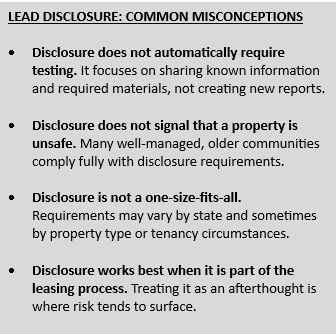
LEAD DISCLOSURE: COMMON MISCONCEPTIONS
|
Disclosure is not a warning sign for residents, but rather information. Residents who receive clear, timely disclosures are less likely to assume information is being withheld or minimized. Clear, timely disclosure helps set expectations and reduces misunderstandings at the outset of the lease.
This transparency often translates into smoother leasing, stronger resident relationships, and fewer disputes. But its primary value remains risk reduction and consistency.
The role of a disciplined management approach
For many owners, the challenge isn’t understanding that disclosure is required; it’s managing the details consistently across properties, teams, and jurisdictions. That’s where the right property management partner adds value.
Effective managers treat disclosure as part of routine operations, not a standalone task. They act as a guide, helping owners understand what matters, where risk tends to surface, and how to maintain alignment without overcomplicating the process. That means:
- Monitoring regulatory changes so owners are not caught off guard
- Creating consistency across properties and leasing teams
- Maintaining documentation that is accessible, complete, and defensible
This disciplined approach reduces friction during audits, legal review, or ownership changes and helps protect owners from avoidable exposure.
A quiet but important differentiator
Lead paint disclosure may never be a headline issue for most multifamily properties, but it remains an important part of responsible ownership. Consistent, well-documented disclosure processes reduce liability and support operational stability.
Done well, disclosure also builds confidence: confidence for owners that the details are being handled thoughtfully, and confidence for residents that they are renting in a professionally managed community.
Owners reviewing disclosure processes across their portfolios may benefit from a structured compliance review to ensure consistency across markets. Contact WPM to discuss how we help owners manage compliance with a disciplined, repeatable approach.