Posts about Multifamily

Why Online Reputation is Your Most Critical Asset-image

  How Online Reputation Impacts Leasing Performance   Prospective residents often form an opinion about an apartment community long before they contact the leasing office or schedule a tour. In many cases, their first impression comes from a Google search, a star rating, recent reviews, and the way the management team responds.   That means online reputation is no longer just a marketing issue. It is directly connected to lead volume, tour conversion, resident trust, and overall leasing performance. A community’s online presence tells the story of the resident experience, and that story can either build confidence or create hesitation.   Star Ratings Shape First Impressions For many prospects, star ratings are an early filter. Before clicking into a community’s website or submitting a lead form, they may compare ratings across properties and quickly narrow their search.   But reputation management is not only about maintaining a high score. It is also about showing consistent, recent feedback that reflects how the community is operating today. Older reviews may still influence perception, but current reviews help tell a more relevant story and balance the occasional negative review every community is likely to receive.   How You Respond Matters, Too Prospects do not just read reviews. They also read management responses. A thoughtful, professional response shows that the team is engaged, accountable, and paying attention. Not all concerns can be fully resolved in a public forum, but the response itself can influence how future prospects perceive the community.   Responses should not sound scripted or defensive. They should be specific, respectful, and, when appropriate, invite the resident to continue the conversation offline. In many cases, a prospect may judge the response as much as, or more than, the original complaint.   Negative Reviews Are Part of the Process Every community receives negative reviews at some point. The goal is not perfection. The goal is consistency, responsiveness, and operational follow-through. One negative review is usually less damaging than a pattern of ignored reviews or repeated concerns that appear unresolved.   When negative feedback reveals a recurring issue, it should be treated as an opportunity to look more closely at the resident experience. Used well, online feedback becomes more than a reputation tool. It becomes an operational insight, helping teams identify maintenance concerns, communication gaps, staffing challenges, or broader resident experience trends.   Reputation Is Built Through Everyday Operations At the core, online reputation is built through the daily experiences residents have with the community. Positive reviews are often tied to simple but meaningful regular interactions, such as: Responsive maintenance Friendly and helpful communication Smooth move-ins Clear follow-up after concerns are addressed Positive resident events and appreciation activities Team members who make residents feel heard and valued   For WPM communities, reputation management is closely connected to the everyday customer service experience. When residents have positive interactions, they are more likely to share them publicly.   Making Reputation Management Part of the Culture A strong reputation requires ongoing attention and team-wide accountability for excellence in customer service, from responding to maintenance requests to communicating regularly with residents.   At WPM, online reputation performance is monitored across apartment communities through a centralized Reputation Report Card. This allows teams to track Google ratings, review volume, review trends, response completion, and overall reputation performance over time. By reviewing reputation data regularly, managers can identify opportunities early and respond proactively. WPM also encourages teams to request reviews during positive resident touchpoints, helping prospective residents see a more current and complete picture of the community experience.     Training Teams to Support Reputation and Performance Reputation management works best when everyone understands their role. WPM provides training and support for leasing teams, service teams, property managers, and regional managers, with a focus on best practices for responses to reviews, resident communication, online reputation trends, and the connection between everyday interactions and leasing performance.   The emphasis is not on eliminating all negative feedback. Instead, the focus is on timely responses, clear communication, operational follow-through, and a steady flow of authentic positive reviews.   A Strong Reputation Starts with the Resident Experience Online reputation reflects what residents experience every day. When teams communicate clearly, respond promptly, follow through on concerns, and create positive moments of connection, residents are more likely to share those experiences.   At WPM, we know reputation management is not about shortcuts or quick fixes. It is earned through consistent, authentic service that adds value for residents, clients, and communities. When the service is strong, the online perception aligns with the lived experience. That is the foundation of performance that adds value.  

Read more
What Multifamily Owners Need to Know About Lead-Based Paint Disclosure-image

For owners of multifamily properties, regulatory requirements are part of the cost of doing business. Many are familiar, some are complex, and most require consistent execution to avoid unnecessary risk. Lead-based paint disclosure is one of those requirements where doing it right, every time, matters.   In established multifamily markets, a significant portion of housing stock predates 1978. Federal and state regulations require owners of most of these properties to disclose known information about lead-based paint and related hazards before a lease is signed. While the disclosure process itself is well-defined, the risk for owners typically lies not in the rule but in how it is managed day to day.   Disclosure as a risk management issue Lead disclosure requirements exist to reduce risk for both residents and for owners. From an ownership perspective, the exposure is primarily legal and financial. Federal law allows for significant penalties when required disclosures are missed or improperly handled, and enforcement actions often focus on documentation, timing, and record retention rather than intent.   In practice, disclosure-related issues tend to surface in predictable moments: audits, complaints, legal review, or ownership transitions. Inconsistent processes across a portfolio, incomplete records, or informal leasing practices can create gaps that are difficult to correct after the fact.   For owners, the key takeaway is straightforward: disclosure is not a one-time administrative task. It is an operational control that needs to function reliably across properties and leasing teams.   What owners should understand at a practical level At a high level, lead disclosure requirements are built around a few core expectations: Disclosure must occur before lease execution, and timing matters. Known information must be shared, including existing reports or records, where applicable. Acknowledgment and documentation are critical and must be retained for defined periods. Processes must be repeatable across units, properties, and markets.   State-specific requirements may add additional obligations, particularly for properties located in jurisdictions with more detailed lead paint laws. Owners operating across multiple states benefit from an approach that accounts for these variations without relying on ad hoc judgment at the site level.   Where risk tends to show up From an owner-risk standpoint, disclosure issues most often arise not because requirements are unknown, but because execution breaks down, particularly as portfolios grow, teams change, or processes evolve.   Common pressure points include: Leasing teams working from outdated forms Disclosure materials not being provided uniformly across properties Records that are incomplete or difficult to retrieve Growth or turnover that outpaces process updates   These gaps can increase exposure even for otherwise diligent owners. The operational challenge is ensuring that disclosure is embedded into leasing workflows in a way that holds up over time.     LEAD DISCLOSURE: COMMON MISCONCEPTIONS   Disclosure does not automatically require testing. It focuses on sharing known information and required materials, not creating new reports. Disclosure does not signal that a property is unsafe. Many well-managed, older communities comply fully with disclosure requirements. Disclosure is not a one-size-fits-all. Requirements may vary by state and sometimes by property type or tenancy circumstances. Disclosure works best when it is part of the leasing process. Treating it as an afterthought is where risk tends to surface. Transparency builds trust Disclosure is not a warning sign for residents, but rather information. Residents who receive clear, timely disclosures are less likely to assume information is being withheld or minimized. Clear, timely disclosure helps set expectations and reduces misunderstandings at the outset of the lease.     This transparency often translates into smoother leasing, stronger resident relationships, and fewer disputes. But its primary value remains risk reduction and consistency.   The role of a disciplined management approach For many owners, the challenge isn’t understanding that disclosure is required; it’s managing the details consistently across properties, teams, and jurisdictions. That’s where the right property management partner adds value.   Effective managers treat disclosure as part of routine operations, not a standalone task. They act as a guide, helping owners understand what matters, where risk tends to surface, and how to maintain alignment without overcomplicating the process. That means: Monitoring regulatory changes so owners are not caught off guard Creating consistency across properties and leasing teams Maintaining documentation that is accessible, complete, and defensible   This disciplined approach reduces friction during audits, legal review, or ownership changes and helps protect owners from avoidable exposure.   A quiet but important differentiator Lead paint disclosure may never be a headline issue for most multifamily properties, but it remains an important part of responsible ownership. Consistent, well-documented disclosure processes reduce liability and support operational stability.   Done well, disclosure also builds confidence: confidence for owners that the details are being handled thoughtfully, and confidence for residents that they are renting in a professionally managed community.   Owners reviewing disclosure processes across their portfolios may benefit from a structured compliance review to ensure consistency across markets. Contact WPM to discuss how we help owners manage compliance with a disciplined, repeatable approach.

Read more
Navigating the Changing Legal Landscape of Multifamily Real Estate-image

Today’s legislative environment continues to evolve, introducing new laws and regulations that add complexity for multifamily property owners and managers. While most are designed to enhance fairness and transparency for residents, they also bring added administrative and financial challenges for property owners. Partnering with a management firm that has in-house legal counsel helps to navigate these changes in a cost-effective and streamlined manner.   The Impact of Newly Enacted Laws In Maryland alone, new laws passed this year have created additional requirements for property managers. The Maryland Tenant Possessions Recovery Act created statewide eviction notice obligations to ensure residents are fully informed.  However, this law also added significant administrative work. Property teams must now email, mail, and post eviction notices, maintaining proof of completion for each step.   Other laws share the same goal of transparency but require affirmative steps taken by property managers to stay compliant. The Maryland Tenant Mold Protection Act , among other things, requires a pamphlet to be included with the lease agreement, which provides residents with educational materials and disclosures about mold. Maryland’s Pet Policy Transparency Act mandates that every property’s pet policy appear in both rental applications and on the property’s website. Even well-intentioned measures like these can cause confusion or unnecessary concern among residents if not communicated and implemented clearly.   Property owners would benefit from working with a property management company that stays ahead of changing legislation and proactively works toward compliance.   Benefits of Compliance Compliance is about more than avoiding penalties; it protects both people and property. When laws are followed precisely, residents receive fair treatment and owners avoid legal exposure, financial loss, and reputational damage. Missteps can be costly and can lead to lawsuits or discrimination complaints that may take months and significant expense to resolve.   At WPM, compliance is not bureaucracy. It is a matter of trust. For us, compliance is a top priority that starts with in-house legal counsel and continues through the on-site property teams. By aligning legal expertise with day-to-day management, we protect our clients’ investments while ensuring residents are treated with fairness, consistency and respect.   The Legal Work Behind Every Property Behind every well-run community is a framework of documents, procedures, and safeguards that make it all work. In multifamily real estate, legal counsel plays two essential roles: prevention and protection.   On the preventative side, counsel develops and continually refines leases, addenda, and disclosures that define the landlord-tenant relationship. Each year brings new legislative requirements that must be reflected accurately in every lease. Getting it right from the start helps to keep owners protected and residents informed.   On the protective side, counsel steps in when disputes arise. Rent cases, lease violations, and Fair Housing requests demand a detailed understanding of both the law and the property itself. How these issues are handled can mean the difference between a quick resolution and costly litigation.   When legal expertise is integrated with daily operations, properties run more efficiently, risks are minimized, and relationships are managed with fairness and professionalism.   The Value of In-House Legal Counsel Property management firms with in-house legal counsel offer a clear advantage for owners and residents alike. For residents, knowing the community you live in is run by a management firm with in-house legal counsel should lend confidence that you are renting from a company that takes legal compliance seriously – which translates to fair treatment and better communication.   For owners, this model delivers greater efficiency and lower overall cost. In-house counsel shares the same priorities as the management team: protecting the asset, maintaining resident satisfaction, and ensuring smooth operations. Their role is not to generate billable hours, but to prevent problems before they occur and resolve them quickly when they do.   At WPM, that owner-aligned mindset is central to how we operate. We treat every property as if it were our own, balancing compliance with common sense and legal precision with fairness. When specialized or state-specific issues arise, our in-house counsel partners with trusted outside attorneys, adding another layer of expertise and accountability.   Raising the Standard for Owners and Residents Alike Managing a multifamily property today means managing complexity. New laws, stronger tenant protections, and added documentation requirements have raised the stakes for everyone. The right management partner safeguards both owners and residents by keeping communities well-run, fair, and fully compliant.   When evaluating a property management firm, consider whether it has in-house counsel that: Stays ahead of legislation by updating leases, disclosures, and policies before changes take effect. Handles Fair Housing requests and tenant disputes with empathy and sound legal judgment to ensure fairness for all parties. Maintains clear communication and documentation so residents understand their rights and responsibilities and owners know their properties are protected. Coordinates effectively with outside legal experts and ensures every action is compliant, efficient, and transparent. Balances protection with people, creating communities where compliance and care go hand in hand.   Firms that uphold these standards build communities rooted in trust, consistency, and accountability. They create environments where residents feel respected and owners know their investments are in capable hands. The laws may keep changing, but the principles stay the same: treat people fairly, manage responsibly, and everyone benefits.  

Read more
How WPM is Using AI in the Leasing Process-image

Meeting Renters Where They Are: How AI Is Reshaping the Multifamily Experience Technology continues to change how we live, work, and connect – and today’s renters expect their apartment search and leasing journey to keep up. Just like they shop online, book travel, or order groceries, renters want information and access on their own terms: anytime, anywhere, and from any device.   The 2024 NMHC & Grace Hill Renter Preferences Survey , based on more than 170,000 renter responses, highlights just how much expectations have shifted. Renters say they prioritize real-time pricing, availability, and floorplans online, and increasingly expect virtual tours, online applications, and digital communication options. Convenience is no longer a “nice to have.” It’s a deciding factor.   At WPM, we’re committed to meeting those expectations while also delivering stronger results for our clients. That’s where AI-powered tools come in. By adopting, testing, and refining these solutions, we’re creating more efficient, personalized experiences for residents, while driving measurable value for owners.   Performance That Adds Value    Across our multifamily portfolio, AI-driven engagement has made a measurable difference. We’ve seen a 33% increase in tours and a 38% increase in leases (Jan–July year-over-year) , along with faster move-ins that reduce vacancy loss and boost net operating income (NOI). This level of responsiveness can mean the difference between choosing one property over another.   For residents, that means easier scheduling, faster applications, and quicker move-ins. For owners, it results in higher occupancy and stronger returns.   When compared to similar properties in the region, WPM communities are consistently outperforming. On average, our properties generated 23% more tours , 43% more applications , and nearly 10% more leases than the regional benchmarks.   These numbers highlight how our strategic use of AI, coupled with the power of WPM’s onsite teams, is helping properties deliver service excellence and stronger results. Not all management companies are approaching this with the same focus, and without effective use of AI, opportunities to better serve residents and improve outcomes for owners may be overlooked.   A Commitment to Improvement   As AI advances, these tools, when used strategically, help us keep pace with changing consumer expectations while strengthening operations and service. At WPM, we view AI as part of a cycle of verification, adjustment, and improvement, reflecting our broader commitment to continual progress and ensuring our performance creates value for both residents and owners. By analyzing the data and making refinements, we ensure these tools continue to drive engagement and efficiency. Just as importantly, this approach helps us identify new opportunities for coaching and process enhancements that strengthen our overall operations.   Looking Ahead   As AI continues to evolve, its greatest potential lies in moving beyond convenience to create more personalized and seamless experiences. For properties, that means anticipating renter needs before they ask, simplifying the journey from first inquiry to move-in, and freeing onsite teams to focus on the human side of service. What was once considered cutting-edge technology is quickly becoming the standard, and properties that use it well are positioned to deliver the kind of experience today’s residents not only prefer, but expect.   For WPM, it means making it easy for renters to search, tour, and apply across devices, while also streamlining move-ins and giving our onsite teams more time for relationship-building. It’s about using tools like AI to elevate what matters most: exceptional resident experiences and exceptional client results.  

Read more
The Vital Role of a Service Technician in Multifamily Real Estate-image

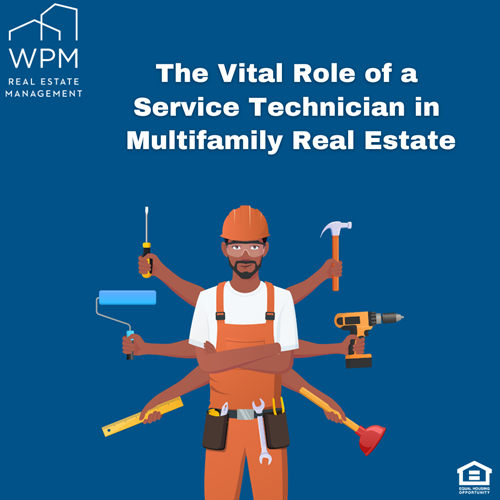
In the multifamily real estate industry, service technicians play a critical role in ensuring that apartment communities run smoothly and efficiently. Often described as the "jack of all trades," this is an understatement. These professionals need a diverse skill set that includes basic knowledge of electricity, plumbing, and HVAC systems. Their ability to tackle a wide range of maintenance issues makes them indispensable to property management teams.   In addition to routine maintenance issues, service technicians also handle preventive tasks, like changing HVAC filters, clearing dryer vents, and cleaning gutters. Their work helps avoid the need for costly repairs and replacements. Service technicians and the entire service team also play an important role in resident satisfaction, which affects the community’s overall success. Satisfied residents stay longer, reducing turnover and marketing expenses for the property.   Daily Responsibilities Service technicians are responsible for a myriad of maintenance tasks within an apartment community. Their day typically starts with a list of work orders assigned by the service manager, who is also a working manager tackling their own set of work orders. These tasks can include:   - Fixing defective outlets, switches, light fixtures, and faucets - Diagnosing and repairing stove and other appliance issues - Replacing fixtures and appliances - Unclogging drains in tubs, sinks, and toilets - Repairing cabinetry and replacing sinks - Caulking and tile replacement in bathrooms and kitchens   No two days are alike for a service technician. One day might be spent entirely on plumbing issues, while the next could be dedicated to HVAC repairs. The workload can vary significantly, with some tasks taking just an hour and others, like major HVAC repairs, potentially consuming an entire day. This variety requires technicians to be flexible and quick to adapt to changing priorities.   In addition to routine maintenance, service technicians are also on call for emergencies. Depending on the size of the property, they might be on an emergency call rotation, ensuring that urgent issues are addressed promptly. This on-call duty requires technicians to be adaptable and ready to handle any situation that arises, often making them the first point of contact for residents facing maintenance problems. Service technicians are often offered reduced rental rates to live at the property or another nearby property in the company’s managed portfolio to help ensure faster response times to emergencies.   Training and Skill Development Training is also a key component of a service technician's day. WPM has developed a robust approach to maintenance and service training, helping technicians strengthen their skills and experience. In-field training allows new technicians to learn on the job from more experienced professionals, and regular training sessions help all team members stay updated on the latest maintenance techniques and safety protocols. Through this continual learning environment, service technicians gain the skills, experience, and confidence to handle a wide range of service and maintenance issues. Additionally, our 12-month Service Mentoring And Response Training (SMART) program is designed to give rising team members the skills to successfully move into leadership positions within the organization.   Career Growth Opportunities Entry-level technicians should have a basic understanding of electricity, plumbing, and appliance repair. Over time, they can expect to gain advanced skills through on-the-job training and additional courses. The role also requires strong people skills, as technicians often interact with residents, addressing their concerns and ensuring their satisfaction.   For those interested in expanding their skill set and advancing their career, there are multiple opportunities for growth. Technicians can advance to assistant service manager and service manager positions at a single property and eventually to a senior area service manager role, overseeing maintenance needs of multiple properties and managing larger teams. There is no set timeline for these promotions; progression depends on individual effort and acquired skill sets.   ---------------- “Being a Service Technician opened my mind to new perspectives and fueled my desire to help others. Each day brings new learning opportunities, and I am grateful for the chance to share my knowledge while continually expanding it.” – Frank Rocco, Service Manager, WPM Real Estate Management (promoted from Service Technician) ----------------   Preparing for the Role For those interested in becoming a service technician, technical schools offer valuable training in essential skills like electricity, plumbing, and HVAC systems. For those who cannot afford formal education, starting as a site technician at a property provides a pathway to gain experience and learn about working in property management service. Some companies, like WPM, also offer in-house training and mentorship programs, allowing new hires to develop their skills and advance their careers.   Final Thoughts The role of a service technician in multifamily real estate is both challenging and rewarding. It requires a versatile skill set, adaptability, and a willingness to continuously learn and improve. For those who enjoy a dynamic work environment and the satisfaction of solving problems, this career offers numerous opportunities for growth and development.   Interested in a career in multifamily property management service? Visit https://www.wpmllc.com/careers   to explore the opportunities at WPM Real Estate Management and join our team of quality service professionals.   

Read more
The Goldilocks Principle: Maintenance Advantages of the Right-Sized Property Management Company-image

For multifamily real estate owners and community association boards, selecting a property management firm can be quite an undertaking. It’s a fragmented market – everything from small, owner-operator managers with one or two employees who “do it all” to huge, national and international companies that manage billions of dollars of real estate and thousands of communities.  While there are pros and cons to each, one area that is often overlooked during due diligence in choosing a property manager is how a company’s size affects its maintenance operations.   Major national operators have untold lists of vendors, often vetted through a procurement process that can be bureaucratic. Depending on the location of the property or the type of service needed, vendor bids are reviewed and selected by individuals who may or may not have even stepped foot on the property. On the other end of the spectrum, small operators often lack the size to attract larger vendors or competitive pricing, opting to funnel work through a handful of smaller vendors they know, but who may or may not be best suited for the work.   Working with a regional management firm provides a sweet spot for communities who recognize the importance of maintenance operations in preserving the value of their assets and optimizing the return on their investment.   As a large, regional property management firm, WPM knows what it takes to attract and work with high quality vendors and how to maximize maintenance operations. Here are a few considerations and why size matters to your community’s maintenance operations (and bottom line!). Vendor Selection. No one wants to find out in the middle of a project that the company doing work on your community roof wasn’t insured properly or lacked appropriate licensing. So it’s important that your property management company has a fair and rigorous process for due diligence on vendors. WPM works with a reputable, third-party provider to vet prospective vendors, determine and track insurance verifications, assess fit for multifamily and/or association communities, and evaluate performance against our standards of excellence. Not all vendors are a fit for all property types. Only after a thorough review are vendors approved to be a preferred partner for one of our divisions and eligible to bid on projects for the communities we manage. Buying Power. Having a portfolio that represents a sizeable potential market to vendors provides a management company with access to a larger pool of high-quality vendors. This helps secure more competitive, bulk, and volume-based pricing. WPM’s size creates a spend that is large enough that vendors are willing to create discount pricing for things like flooring, cabinetry, fixtures, HVAC equipment and supplies, roofing, paint, landscaping materials, and so much more, because they know that over the course of the year we will purchase a significant volume across our communities. This means we’re not purchasing at retail rates, but rather securing lower commercial or hybrid rates, locking into a discounted rate for purchases made throughout the year. In the end, these savings benefit our clients, both financially and operationally, eliminating the need to inventory or store items in order to receive lower pricing.    Quality & Relationships. Size also affects the depth of relationships a company can have with its vendors. Does the company have a direct line to the vendor contact to resolve issues? While competitive pricing is important, having strong relationships with vendors who have mutual respect for quality work and a shared commitment to doing what’s right when things go sideways (which, unfortunately, they can sometimes do) can mean the difference between successful projects and costly re-work and blame games. WPM has spent decades building trusted relationships with preferred partners throughout the Mid-Atlantic region – from setting clear expectations for quality and service to ensuring fair pricing, accountability, and quick resolution to any issues. We have a shared goal to deliver exceptional value to the clients we serve. Staff & Contractor Management. How a property management company uses its team can provide insight into how well they optimize your maintenance budget. Do they try to keep everything in house, deferring maintenance projects they can’t get to? Or do they leverage outside contractors for time-consuming and specialty-skilled work? Bringing in a contractor to make sure work gets done properly can minimize the impact of delays and deferred maintenance. WPM’s team takes pride in carefully evaluating the work to be done and identifying the most cost-efficient and productive way to deliver quality results. In the end, this ensures the highest level of service for our clients.    Knowing how size can affect the way maintenance is handled for your property or community can be beneficial in selecting a property manager. What may appear relatively mundane or unimportant can actually have greater implications over time for the value of your property. In the end, size does matter. Take the time to really explore this aspect to ensure you have the right-sized management company to manage your community.   

Read more